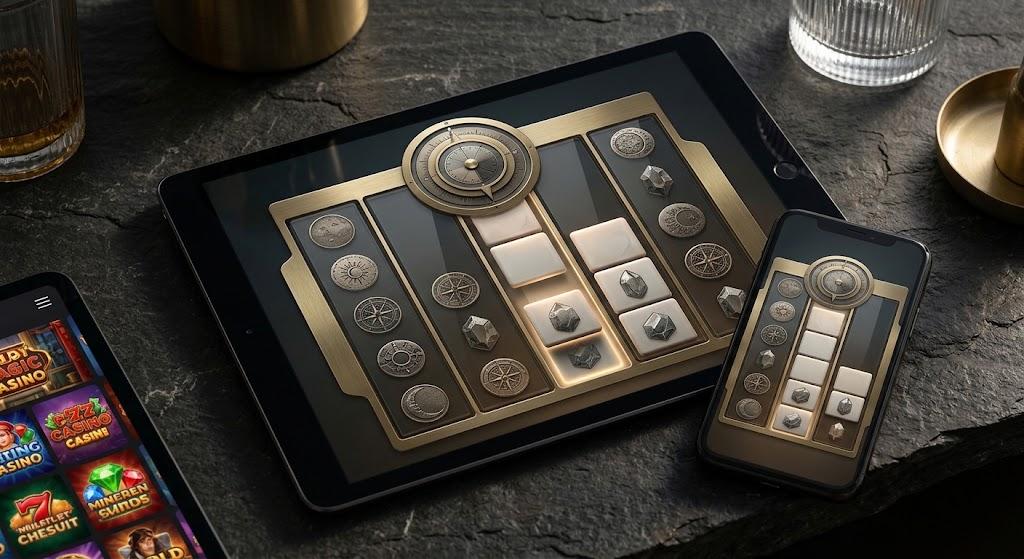
Take thirty seconds to browse any online casino in 2026, and you’ll begin to see all the games blend together. You’ll notice designs inspired by volcanic eruptions and ancient gods. Other designs may include a cityscape or even a sugar skull. While games may feature unique artwork and designs, after a while they all start to look the same. You’ll realize what separates games goes far beyond art.
It’s important to consider what a design achieves once it captures your attention. A design may feature unique artwork and style, but if the game becomes stale quickly, the art and design lose their value. The architecture and structure of a game help the player understand game rules and engage with the game. If every aspect of a game serves a purpose, then that game is intended to be enjoyable.
Building this architecture is considerably harder than designing artwork. A game’s artwork and designs aren’t everything.
The First Five Seconds
Game designers obviously want to convey key ideas and rules within the first few seconds of interacting with a game. Casino slot game designers are masters of this. Game elements, symbols, and rules are created to teach the player with the least amount of effort on their part. Rules are designed so that a player is always chasing something and the meter tells them what to chase. Clever design gets the spin button in the optimum spot for the user to reach.
The best casino slot games incorporate the use of visual hierarchy to teach the player without the player being aware that they have learned something. Elements of a game are arranged so that the designer decides what the player is to attend to. Artwork is arranged so that the player does not have to attend to anything other than what the designer intends them to. If a game is designed poorly, the player is forced to do all the work and figure out what the game intends them to do, usually causing player fatigue.
If the mechanical framework is clear, the designer has a better opportunity to explore and showcase the theme of the game. When a mechanic is weak, design choices become very restrictive.
A Continent of Screens
On-line casino gambling is one of the larger segments of Europe’s entertainment industry. European online gambling has several national markets, and perhaps nowhere else in the world is there as great an opportunity to capture a diverse, transnational audience as there is in Europe. The United Kingdom and Germany are two of the largest European online gambling markets. In terms of markets, Sweden is at the top in terms of the percentage of gambling that happens online. The online gambling markets in the southern and eastern countries of Europe that liberalized their gambling markets in the 2010s have developed a discerning audience in terms of graphic and user interface design. Romania is located in that region. Audiences there, as well as many others across Europe, have access to multiple gambling sites. Don Casino is one place where readers encounter the broader European casino landscape. Europe’s designers understand that clarity and coherence in design are easily appreciated across borders.
What Your Eyes are Told to Do
Put two slot machines next to each other, and you’ll immediately notice which one is more organized. The better one has a focal point, probably a main reel cluster or jackpot meter. Bad organization is noticeable as well, probably as multiple pay tables that animate on and off the screen, or multiple flashing meters. It’s like everyone in a room trying to scream the loudest.
Trying to design something to create an atmosphere is good. A slot machine can easily do that by using nice graphics and contrast. Many newer machines do this instead of using ornate designs of older machines. A nice contrast of fonts and colors is better than trying to use a nice font and good contrast with a messy background. For example, using a legible font to show a jackpot is nice and easy. Using a nice old-timey font and putting it over a busy background of a dungeon is cool, but really hard to read. If you have to think about it, that’s a bad design.
Of all the contrasts involved in game design, that between motion and stillness is the most important. The best game designs show restraint when incorporating animation and increase motion to represent intensity during near wins, big payouts, and bonus activations. The contrary is true during normal game play. Without effective use of contrasts, games can quickly feel boring and monotonous. The best game designs save animation for true game events. Like italics in a written work, effective use of animation creates emphasis on true game events. When animation is used everywhere, it quickly becomes meaningless.
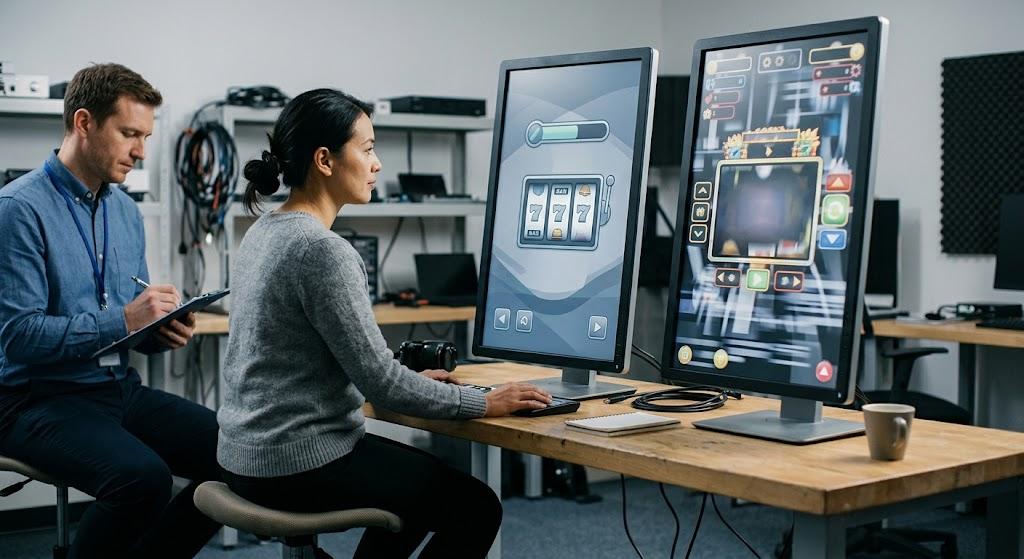
Sound, Motion, and the Art of Not Shouting
Good design of games and other player experiences involves using all of the available means to engage the audience to the greatest possible extent in the expression of the designer’s purpose. Good design incorporates both motion and quiet. While animation quality is very important, timing is usually more important. Good design captures the emotions of players in the places where the emotions are most likely to be felt. Players respond unconsciously to these design features and are often unaware that they have responded to them.
Art used in stylized fashion is naturally adapted for this medium and has essentially become the standard in the industry. Photorealistic art has the potential for a very high level of detail, but that detail quickly becomes a hindrance when the image must be compressed for play on mobile devices. Art that is stylized lends itself to compression. For example, the adventurer is easily identifiable in a small image, and so is the fruit symbol. A clear silhouette and limited palette help the design stay immediately identifiable at any size. The Egyptian explorer is instantly recognizable no matter what size the image of the game is displayed at.
The same approach can be taken with audio. If a game uses a limitless audio palette, the sounds become chaotic and confusing. If a game uses a sparse audio palette, and distinct sounds are created for events in the game, the sounds create a road map for the players.
Many newer games use color palettes with less saturated colors. This can reduce player fatigue.
Mobile-first Design
Designing for a mobile experience isn’t simply making changes to layout based on screen size. Designing for mobile experiences is a production philosophy that impacts the earliest stages of game development, even before concepts are sketched. With this philosophy, game designers start with the end in mind, building for the mobile experience and then expanding to larger experiences. Traditionally, designers start with the desktop experience and reduce to mobile.
Art for a mobile experience must be designed differently to account for the sizes of displays, and the ability to read information in varying lighting conditions. This is why many slot symbols contain geometric shapes as opposed to illustrations, as illustrations might include shading. It’s also why the spin button is situated lower on the screen, within the thumb’s reach so that it doesn’t require a grip adjustment. It’s also why remaining information is collapsed and presented in an accordion format, so that it doesn’t take up space on the screen and reduce the size of the play area.
Designs for desktop computers have dominated casino game design, and the porting of these designs to mobile platforms has resulted in several frustrating design choices. In these games, information can still be arranged horizontally to fit a widescreen aspect ratio. Mobile game designers need to take existing portable game UX and UI into consideration to remove minor, yet cumulative, flaws that ultimately ruin player experience. Developing for mobile natively allows for a greater degree of control in game design.

Memorability in Casino Games
In casino games, memorability is the result of a combination of a variety of different aspects of the game. These aspects may include the type of mechanics used in the game, animations and other art resources, and the design of the user interface. When all of these aspects of the game agree with each other, players are more likely to remember the game.
The games you remember the most are the games where the theme and the mechanics harmonize. The sound design is an enhancement to the overall experience. With this type of game design, the rules aren’t something you have to learn once and then ignore. This type of coherence with game design is hard to achieve. With so many new releases each month, coherence stands apart from the rest. Coherence allows game designers to reach players in any market, anywhere, and gives players a gaming experience that respects their time rather than one that was merely thrown together and demands their attention.